.jpg)
.png)
If you have ever sat at a kitchen table helping your child study for a test, you have witnessed a strange phenomenon.
Your child reads the textbook chapter. They highlight the important parts. They nod along as you explain the concepts. They seem to understand everything. The night before the test, they review their notes and say confidently, "I've got this."
Then the test comes back. The grade is mediocre at best. When you ask what happened, they shrug: "I don't know. I knew it when I studied."
This is not a failure of intelligence or effort. This is a failure of method. And science has known why for decades—schools just have not been listening.
The Learning Pyramid
There is a model called the Learning Pyramid, often associated with the National Training Laboratories, that breaks down retention rates based on the method of instruction. It measures how much information a student remembers two weeks after engaging with the material.
The numbers are devastating for traditional education.
At the very top of the pyramid is the Lecture—the staple of classroom education, the primary method of delivery for high school and university. The average retention rate for a lecture is a mere 5 percent.
That means if a teacher speaks for an hour, the average student walks away retaining only three minutes' worth of information.
Below that is Reading. When a student is told to go home, read Chapter 4, and answer the questions, they are engaging in a method that yields about 10 percent retention.
Audio-visual learning—watching a video or a PowerPoint presentation—bumps that number up to 20 percent.
Demonstration, where a teacher shows a practical application, gets us to 30 percent.
Notice something crucial: these four methods—lecture, reading, audio-visual, and demonstration—make up the vast majority of a student's day in a traditional school. Yet even the best of them fails to cross the 50 percent threshold.
These are passive learning methods. They require input, but they demand very little output.
The Bottom of the Pyramid
The bottom half of the Learning Pyramid is where the magic happens. These are the active learning methodologies.
Group Discussion raises retention to 50 percent.
Practice by Doing—actually solving the problem, conducting the experiment, or writing the code—skyrockets retention to 75 percent.
And at the very base of the pyramid, the most powerful method of all: Teaching Others. When a student has to explain a concept to someone else, their retention rate hits 90 percent.
The implications of this science are profound.
The standard model of "sit still and listen" is scientifically designed to produce forgetfulness.
It explains why a student can attend class every day, nod along, and yet fail the test at the end of the week. They were not learning—they were merely auditing the class.
The Biology Behind the Numbers
This biological reality is rooted in how the brain conserves energy.
The human brain is an incredibly energy-expensive organ, consuming about 20 percent of the body's calories. To survive, it has evolved strict filtering mechanisms. It constantly asks: Do I need this information to survive? Do I need it to achieve a goal?
If the answer is no, the brain discards the data to save space and energy.
When a student listens passively to a lecture, the brain categorizes that information as low-priority background noise. It is similar to walking past a billboard—you see it, but you do not encode it.
However, when a student is forced to produce an answer, to speak, or to solve a problem, the brain switches gears. It signals: Attention! We need this information to perform a task. We must encode this.
The Illusion of Competence
This also explains a dangerous trap known as the "illusion of competence."
A student reads a textbook chapter. The words make sense as they read them. They recognize the concepts. They feel good. They think, "I know this."
But this is a trick of the mind. Recognizing information is not the same as mastering it.
When that same student sits for a test and stares at a blank piece of paper, they panic. They cannot retrieve the information. Why? Because they never actually built the neural pathway to retrieve it—they only built the pathway to recognize it.
They practiced input, but the test requires output.
Applying the Science to Homeschooling
For homeschooling parents, this research is a roadmap.
If you want your child to actually learn—not just perform the motions of studying—you must shift from passive methods to active methods.
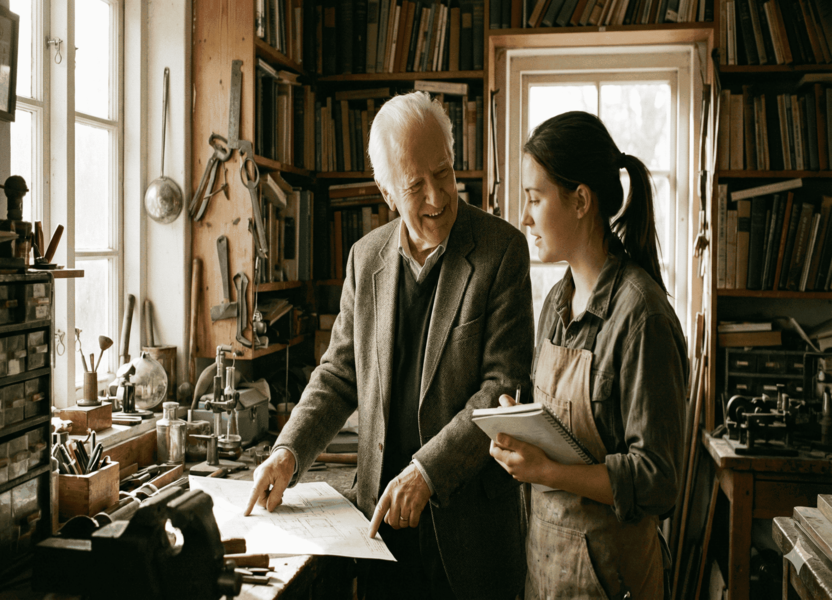
Instead of reading aloud to your child while they listen, have them read aloud to you. Instead of showing them how to solve a math problem, have them explain their thinking as they work through it. Instead of asking "Do you understand?" ask "Can you teach this back to me?"
This is why we built our curriculum around what we call the Speak, Solve, Listen cycle.
Your child does not just read the problem—they hear it read aloud by their AI tutor, GENO. They do not just click an answer—they speak it. They do not just get a grade—they get immediate, conversational feedback.
Speaking is a powerful cognitive act. You cannot speak a coherent sentence about a topic you do not understand. You can nod your head while confused, but you cannot fake an explanation.
By forcing the student to vocalize their math process or their analysis of a reading passage, we force the brain into the active zone. We move the student from the 5 percent retention tier of the lecture to the 75-90 percent retention tier of doing and teaching.
The Efficiency Revolution
Because retention rates are so much higher with active learning—75 to 90 percent compared to 5 percent—your child can learn significantly more in significantly less time.
This shatters the myth that homeschooling requires a parent to lecture for six hours a day.
By leveraging high-retention activities, you can achieve in two hours of focused, active work what a traditional classroom struggles to achieve in a week.
Your child might finish their schoolwork feeling energized rather than drained—because they spent their time in that zone of maximum engagement, racking up small victories and seeing their competence grow in real-time.
The Learning Pyramid is not a theory. It is a proven framework for how human beings actually acquire and retain knowledge. Traditional schools ignore it because they are designed for batch processing, not individual mastery.
You do not have to make the same mistake.
The Complete Homeschool Starter Guide shows you how to implement active learning methods that produce 90% retention instead of 5%. Available now on Amazon.
.jpeg)