.jpg)

Here is a thought experiment that reveals everything wrong with modern education.
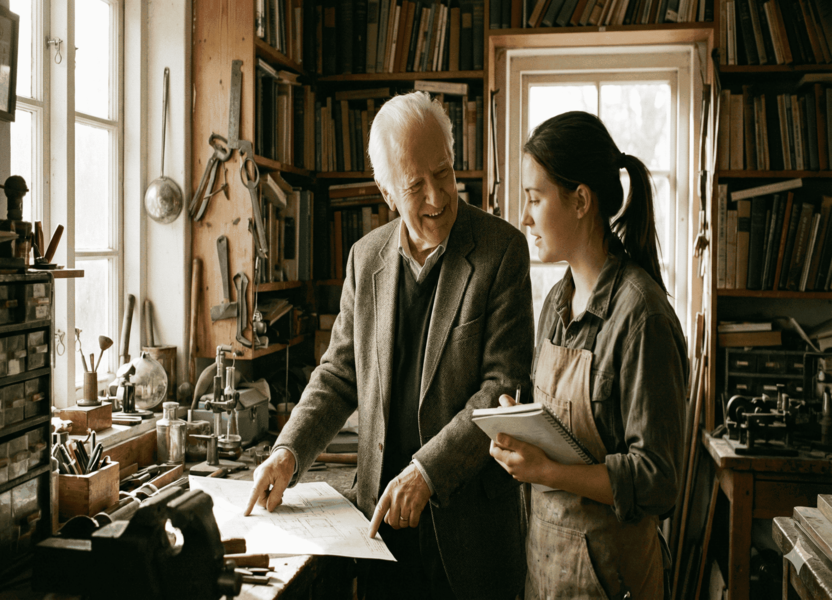
Imagine you possess a time machine capable of transporting people from the mid-19th century directly into our present day. You decide to bring a surgeon from the year 1850 into a modern operating room.
What happens?
Total paralysis. Utter confusion. The robotic arms, the sanitized environment, the heart monitors, and the laparoscopic equipment would look like alien technology. That surgeon would not know how to wash their hands correctly by modern standards, let alone perform a procedure. The field of medicine has advanced so radically that the past is unrecognizable.
Now use that same time machine to transport a schoolteacher from 1850 into a classroom today.
Something very different happens.
While she might be briefly confused by the clothing or the whiteboard replacing the chalkboard, she would instantly recognize her surroundings. She would see children sitting in rows of desks, facing front. She would see a teacher standing at the head of the room, delivering information to a passive audience. She would hear a bell ring to signal the end of a subject.
She would know exactly what to do. She would pick up a marker and begin teaching.
Frozen in Amber
This thought experiment reveals a startling truth about our society. While transportation, communication, medicine, and manufacturing have undergone multiple revolutions, our education system remains frozen in amber.
We are essentially using a 19th-century operating system to run 21st-century hardware.
The glitches, crashes, and incompatibilities you witness in your child's education—the boredom, the anxiety, the lack of engagement—are not bugs in the system. They are features of a design that was never meant for the world your child lives in today.
The Prussian Blueprint
To understand why traditional schooling feels so suffocating for the modern student, we have to look at what it was built to achieve.
The current model of public education was championed in the United States by Horace Mann in the mid-1800s, heavily inspired by the system used in Prussia. At that time, the Western world was undergoing a massive shift from an agricultural economy to an industrial one.
The world no longer needed independent farmers who worked with the seasons. It needed reliable factory workers who could work by the clock.
The industrial tycoons of that era did not require a workforce capable of critical thinking, creativity, or entrepreneurship. In fact, those traits were liabilities on an assembly line. What they needed were workers who were punctual, docile, literate enough to read instructions, and capable of performing repetitive tasks for hours without complaining.
They needed people who would sit still, listen to authority, and move when a bell rang.
The Factory Floor in Disguise
Look closely at the structure of a traditional school, and the factory parallels become impossible to ignore.
We group children by age, regardless of their aptitude or interest, much like a manufacturing plant dates its products by year of assembly. We process them in batches. We move them from station to station—Math, then English, then Science—at the sound of a mechanical bell.
It does not matter if a child is in a state of deep focus and flow in their art project. When the bell rings, the work stops. The schedule dictates the learning, not the learner.
Teachers are evaluated not on whether children actually understand and can apply concepts, but on whether they "covered the material"—as if education were a manufacturing quota to be met.
Students are tested not on their ability to solve real problems, but on their ability to recall standardized answers under time pressure—the exact skill needed to work efficiently on an assembly line.
The Skills That Actually Matter
The factory model was incredibly effective at its original goal: producing compliant workers for an industrial economy. It standardized the population, ensuring that a student in Ohio learned roughly the same things as a student in Oregon, preparing them to slot neatly into the cogs of the national machinery.
But we no longer live in a factory-based economy.
We have entered the Information Age, and we are rapidly transitioning into the Age of Artificial Intelligence. The skills that the factory model suppresses—innovation, unique problem-solving, emotional intelligence, and adaptability—are precisely the skills the 21st century demands.
In the modern world, information is free and omnipresent. Your child does not need to memorize the capitals of all fifty states or the dates of obscure battles. They have the sum of human knowledge in their pocket.
What they need is the ability to synthesize that information, to distinguish truth from fiction, and to apply knowledge to solve novel problems.
Yet our schools are still teaching to the test, prioritizing the memorization of facts over the understanding of concepts. We are drilling children to be encyclopedias in an era of search engines.
The Cognitive Dissonance
This disconnect creates a profound cognitive dissonance for children.
Outside the classroom, they live in a world of on-demand customization. They watch what they want, when they want. They interact with video games that adapt instantly to their skill levels. They use technology to create content, connect with peers globally, and explore niche interests.
Then they walk into a classroom where they are stripped of autonomy and forced to conform to a standardized mold.
The result is a generation of students who are bored, anxious, and disengaged. We label them with attention deficits or behavioral problems, but in many cases, they are simply reacting naturally to an unnatural environment.
A child who cannot sit still for seven hours listening to lectures is not broken. They are human.
A child who asks "why do I need to learn this?" and is not satisfied with "because it's on the test" is not being difficult. They are demonstrating the critical curiosity that leads to real-world success.
Breaking Free
This is why the transition to homeschooling is not just an educational choice—it is a rescue mission.
When you homeschool, you are liberating your child from a system designed to clip their wings and placing them in an environment designed to let them soar.
You are acknowledging that the factory is closed, and it is time to build a laboratory, a studio, and a launchpad in its place.
You are not bound by bells, batches, or bureaucratic curricula. You can let your child dive deep into subjects that fascinate them. You can move at their pace—faster when they grasp concepts quickly, slower when they need more time. You can replace passive listening with active doing.
The 19th century has had its turn. Your child is not a product to be processed. They are sovereign individuals to be empowered.
It is time to design an education for the reality of now.
The Complete Homeschool Starter Guide shows you exactly how to break free from the factory model and build an education that actually prepares your child for the future. Available now on Amazon.
.jpeg)